
Stewart-Treves syndrome, first described in 1948 by Fred Stewart and Norman Treves, is a rare and malignant pathology. It originates from vascular and lymphatic endothelial cells and is generally observed in post-mastectomy patients with axillary dissection, with submission to radiotherapy and consequent lymphatic stasis as a risk factor.(
Female, 68 years old, Caucasian, smoker, admitted to the hospital service in 2010, with extensive lymphedema in the right forearm, on physical examination it was noted a painful and extensive area of raised ulceration of a necrotic and hemorrhagic character (
Figura 1 Cutaneous lesion showing erythematous plaque with coalescing, purple, bullous, and easily bleeding lesions on the right forearm, surrounded by satellite blood blisters, showing diffuse edema.
Figura 2 Microscopy shows a malignant tumor of fusiform, hyperchromatic, high-grade pleomorphic endothelial cells with formation of vascular channels and extravasation of red blood cells at the dermal-subcutaneous junction.
Berger’s surgery (
Figura 3 Resection of the entire upper limb and shoulder girdle, including the scapula and a portion of the clavicle.
Figura 4A. Immediate postoperative period after Berger surgery, with drain; B. Surgical specimen removed in the Berger procedure; C-E. Late postoperative images of the Berger surgery, showing the healing and evolution of the procedure.
In 2017, the patient was hospitalized with heterogeneous complications, of a renal nature classified as chronic kidney disease stage IIIa, and cardiac, characterized by paroxysmal atrial fibrillation, being controlled with clinical measures within the hospital environment and discharged with drug treatment. In the year 2020, the patient returns with complaints of nausea and weight loss, performing multiple biopsies, being diagnosed with esophageal cancer, obtaining a complete response to radiotherapy and gastrostomy with adjustments and changes throughout her life. In 2022, the patient is diagnosed with a new malignant neoplasm in the left breast, requiring hospitalization, as she is a smoker and has chronic obstructive pulmonary disease, she had complications that prevented her from having the surgery to remove the neoplastic nodule, evolving with pneumonia and subsequent sepsis, which led the patient to death.
Stewart-Treves syndrome (STS) is a highly rare, fatally aggressive condition with a poor prognosis, first described in 1948 by Fred Stewart and Norman Treves. The syndrome consists of a tumor originating from endothelial cells with a vascular component resembling a hemangiosarcoma and a lymphatic component resembling a lymphangiosarcoma,(
The age of greatest occurrence of Stewart-Treves syndrome is between 65 and 70 years, representing the predisposition to breast cancer and latency for the progression of chronic lymphedema, and the incidence is 0.07%-0.45% after radical mastectomy. Although STS mostly develops after radical mastectomy, it can manifest as congenital or acquired lymphedema, related to trauma, filariasis, idiopathic lymphoma, venous stasis, morbid obesity, ulcerations in the lower limbs and invasion of the inguinal region by a cervical or penile tumor. The risk of developing the syndrome increases by 15.9% when undergoing postoperative radiotherapy.(
In case of clinical suspicion of Stewart-Treves syndrome, surgical biopsy is essential to prove the disease and rule out other differential diagnoses, as was done in the present case. Currently, immunohistochemistry has been used to prove the epithelial nature of tumor cells.(
In the present case, it was possible to observe a 12-year evolution, much higher than what has been described so far, the patient’s clinical condition and the interventions performed may have contributed to the favorable evolution and survival presented. Treatment possibilities have limited success, being individualized on a case-by-case basis, ranging from large resections, amputation or disarticulation, such as the Berger surgery,(
Chemotherapy therapy can be beneficial when there is a response to the first treatment, radiotherapy is reserved for patients with severe clinical instability or palliative and supportive conditions, the chemotherapy drugs used are: 5-fluorouracil, methotrexate, bleomycin and/or a combination of actinomycin D, vincristine, doxorubicin and cyclophosphamide.(
Clinical follow-up of patients who underwent mastectomy with axillary dissection, radioactive therapy or who had chronic lymphedema is essential, both for a preventive approach and for biopsy of suspicious lesions, corroborating a favorable outcome. In addition, research must be carried out to optimize treatment, aiming at less aggressive interventions and better quality of life for victims of Stewart-Treves syndrome.
EF Collection and assembly of data, Conception and design, Data analysis and interpretation, Final approval of manuscript, Manuscript writing
EF Data analysis and interpretation
LFD Conception and design, Final approval of manuscript, Provision of study materials or patient
LCN Final approval of manuscript
Stewart-Treves syndrome, first described in 1948 by Fred Stewart and Norman Treves, is a rare and malignant pathology. It originates from vascular and lymphatic endothelial cells and is generally observed in post-mastectomy patients with axillary dissection, with submission to radiotherapy and consequent lymphatic stasis as a risk factor.(1) The age of greatest occurrence of Stewart-Treves syndrome is between 65 and 70 years, representing the predisposition to breast cancer and latency for the progression of chronic lymphedema.(2) Diagnosis is usually delayed, as previous lesions have features suggestive of traumatic ecchymosis, pyogenic granulomas or benign vascular proliferations. Early detection of lesions with subsequent biopsy and histopathological conclusion of Stewart-Treves lymphangiosarcoma is essential for a favorable outcome.(3) Although rare and difficult to diagnose, the poor prognosis and high lethality demonstrate the importance of studying this pathology, proving the need for an early diagnosis, rapid and aggressive therapy. The literature reports about 400 cases, of which 360 occurred after ipsilateral mastectomy, as far as we know, this is the only report that demonstrates a survival greater than 10 years developed in the context of five potentially fatal diseases of different neoplastic nature.
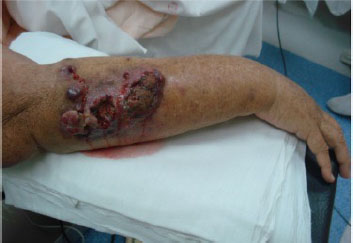
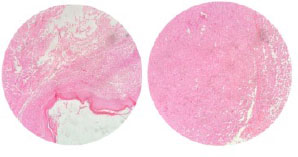
Female, 68 years old, Caucasian, smoker, admitted to the hospital service in 2010, with extensive lymphedema in the right forearm, on physical examination it was noted a painful and extensive area of raised ulceration of a necrotic and hemorrhagic character (Figure 1). A biopsy was performed and the histopathological findings were compatible with Stewart-Treves angiosarcoma (Figure 2). The patient had a history of lung cancer, resection was performed and evolved satisfactorily in 2009. In addition, he underwent quadrantectomy and radical right lymphadenectomy performed 22 years earlier, in adjuvant chemotherapy and radiotherapy at the intervention sites.
Figura 1 Cutaneous lesion showing erythematous plaque with coalescing, purple, bullous, and easily bleeding lesions on the right forearm, surrounded by satellite blood blisters, showing diffuse edema.
Figura 2 Microscopy shows a malignant tumor of fusiform, hyperchromatic, high-grade pleomorphic endothelial cells with formation of vascular channels and extravasation of red blood cells at the dermal-subcutaneous junction.
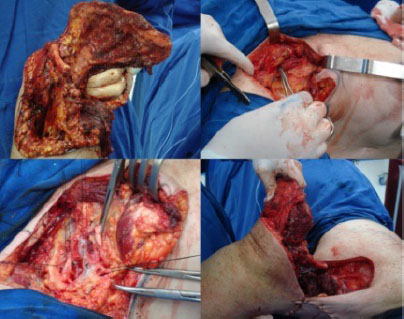
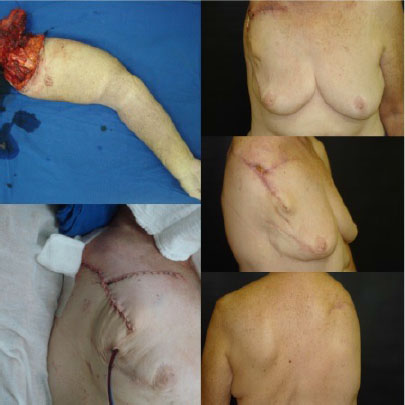
Berger’s surgery (Figure 3) was the viable therapeutic choice for the Stewart-Treves angiosarcoma described in this report. Preoperatively, in addition to laboratory tests, computed tomography (CT) was requested, which revealed alterations in the coronal section of the right part of the upper limb, showing subcutaneous lymphedema throughout the limb. The surgery was successfully performed and without complications, in the postoperative period, maintenance dressings were applied to the surgical wound, progressing satisfactorily (Figure 4), and the patient was discharged 25 days after the therapeutic approach. The surgical specimen was sent to the anatomopathologist showing margins of surgical resection of the specimen, skin and dorsal muscle fragments free of neoplasia, proximal stump showing vascular and neural structures free of involvement and presence of metastasis in a lymph node classified as subclavicular. In addition, the patient underwent control CT every 4 months in the first year after surgery for evaluation and follow-up, after the first year every 6 months.
Figura 3 Resection of the entire upper limb and shoulder girdle, including the scapula and a portion of the clavicle.
Figura 4A. Immediate postoperative period after Berger surgery, with drain; B. Surgical specimen removed in the Berger procedure; C-E. Late postoperative images of the Berger surgery, showing the healing and evolution of the procedure.
In 2017, the patient was hospitalized with heterogeneous complications, of a renal nature classified as chronic kidney disease stage IIIa, and cardiac, characterized by paroxysmal atrial fibrillation, being controlled with clinical measures within the hospital environment and discharged with drug treatment. In the year 2020, the patient returns with complaints of nausea and weight loss, performing multiple biopsies, being diagnosed with esophageal cancer, obtaining a complete response to radiotherapy and gastrostomy with adjustments and changes throughout her life. In 2022, the patient is diagnosed with a new malignant neoplasm in the left breast, requiring hospitalization, as she is a smoker and has chronic obstructive pulmonary disease, she had complications that prevented her from having the surgery to remove the neoplastic nodule, evolving with pneumonia and subsequent sepsis, which led the patient to death.
Stewart-Treves syndrome (STS) is a highly rare, fatally aggressive condition with a poor prognosis, first described in 1948 by Fred Stewart and Norman Treves. The syndrome consists of a tumor originating from endothelial cells with a vascular component resembling a hemangiosarcoma and a lymphatic component resembling a lymphangiosarcoma,(1,2) develops due to failure in lymphatic drainage, which causes the storage of interstitial fluid and corroborates with lymphatic stasis, therefore, immunity collapses in a chronic course with malignant characteristics, affecting mainly the upper limbs, and the lesions appear in descending order: arm, forearm, wrist and anterior thorax, and can generate metastasis in any organ, through the hematogenous route.(4)
The age of greatest occurrence of Stewart-Treves syndrome is between 65 and 70 years, representing the predisposition to breast cancer and latency for the progression of chronic lymphedema, and the incidence is 0.07%-0.45% after radical mastectomy. Although STS mostly develops after radical mastectomy, it can manifest as congenital or acquired lymphedema, related to trauma, filariasis, idiopathic lymphoma, venous stasis, morbid obesity, ulcerations in the lower limbs and invasion of the inguinal region by a cervical or penile tumor. The risk of developing the syndrome increases by 15.9% when undergoing postoperative radiotherapy.(2)
In case of clinical suspicion of Stewart-Treves syndrome, surgical biopsy is essential to prove the disease and rule out other differential diagnoses, as was done in the present case. Currently, immunohistochemistry has been used to prove the epithelial nature of tumor cells.(3)Immunohistochemical study shows generally positive staining for endothelial cell markers such as antibodies against factor VIII, type IV collagen and CD31. Overexpression of c-MYC is essential for angiogenesis and is strongly related to secondary angiosarcoma,(5) in addition to alterations in the somatic deletion of the TP53 gene present in the immunodetection of the mutant p53 protein, related to DNA breakage induced by the irradiation of adjuvant therapy, corroborating with a worse prognosis and a more aggressive biological marker of soft tissue tumors.(3) Stewart-Treves syndrome has a poor prognosis, favoring local recurrence and distant metastasis, since after diagnosis survival is approximately 30 months, whereas in untreated patients survival decreases to 5-8 months.(2)
In the present case, it was possible to observe a 12-year evolution, much higher than what has been described so far, the patient’s clinical condition and the interventions performed may have contributed to the favorable evolution and survival presented. Treatment possibilities have limited success, being individualized on a case-by-case basis, ranging from large resections, amputation or disarticulation, such as the Berger surgery,(7) being indicated in the condition of large tumors intimately connected to the main nerves or to the vascular supply of the upper limb, as is the case of Stewart-Treves syndrome.(6) Interscapulothoracic disarticulation is performed after anesthesia, intubation and bladder catheterization of the patient, the surgical technique consists of positioning the patient in total lateral decubitus, with a medial incision being made in the sternoclavicular joint, extending laterally along the clavicle and bending down towards the posterior axillary line. The upper part of the elliptical incision starts at the sternoclavicular joint, runs along the clavicle, then runs toward the supraclavicular region, posteriorly toward the acromion, and curves along the posterior axillary line to join the anterior incision. The dissection is exposed up to the level of the deep fascia, and an anterior flap is made showing the pectoralis major muscle that will be dissected to expose the pectoralis minor, after which the clavicular head of the sternocleidomastoid muscle is sectioned close to the clavicle, and then the clavicle is divided into the its middle third. The large vessels and nerves that supply the dissected region are isolated, cut and ligated. With the surgeon located posterior to the patient, the incision is completed with a dorsal flap, exposing the muscle insertions of the trapezius and latissimus dorsi, then the levator scapulae and rhomboid muscles are sectioned and the suprascapular and transverse cervical vessels are isolated, sectioned and sutured. Finally, the serratus anterior muscle is divided at its origin on the thoracic wall, completing the entire resection, obtaining bone, vascular, lymphatic limits and approximation by contiguity of the surgical specimen, thus justifying the need for scapulectomy.(7,8)
Chemotherapy therapy can be beneficial when there is a response to the first treatment, radiotherapy is reserved for patients with severe clinical instability or palliative and supportive conditions, the chemotherapy drugs used are: 5-fluorouracil, methotrexate, bleomycin and/or a combination of actinomycin D, vincristine, doxorubicin and cyclophosphamide.(3) Recent studies have demonstrated, through immunohistochemical staining of IL-23 and IL-17, the presence of IL-23 and IL-27 producing cells, important for tumor angiogenesis, in addition to promoting neoplastic advancement by blocking apoptosis, as well as attracting neutrophils and macrophages supporting the formation of cytokines and vascular endothelial growth factors in the injured tissue. This analysis provided innovation in the treatment of Stewart-Treves angiosarcoma, with the injection of Guselkumab, a monoclonal antibody directed at IL-23p19, which requires thorough investigation, but indicates a great therapeutic potential for the syndrome.(9)
Clinical follow-up of patients who underwent mastectomy with axillary dissection, radioactive therapy or who had chronic lymphedema is essential, both for a preventive approach and for biopsy of suspicious lesions, corroborating a favorable outcome. In addition, research must be carried out to optimize treatment, aiming at less aggressive interventions and better quality of life for victims of Stewart-Treves syndrome.
EF Collection and assembly of data, Conception and design, Data analysis and interpretation, Final approval of manuscript, Manuscript writing
EF Data analysis and interpretation
LFD Conception and design, Final approval of manuscript, Provision of study materials or patient
LCN Final approval of manuscript
Journal: Brazilian Journal of Oncology
DOI: 10.1055/s-00059887
e-issn: 2526-8732
Publisher: Thieme Revinter Publicações Ltda.
Publisher address: Rua do Matoso 170, Rio de Janeiro, RJ, CEP 20270-135, Brazil
Falha na comunicação com o serviço de processamento. Tente novamente.
1. Wierzbicka-Hainaut, E and Guillet, G. Syndrome de Stewart-Treves (angiosarcome sur lymphœdème): complication rare du lymphųdème. Presse Med [online]. 2010, vol. 39, p. 1305-8.
2. Wang, LL and Cui, LF and Gao, Y and Jiang, ZC. Clinicopathologic features of Stewart-Treves syndrome. Int J Clin Exp Pathol [online]. 2019, vol. 12, p. 680-8.
3. Pereira, ESP and Moraes, ET and Siqueira, DM and Santos, MAS. Stewart-Treves syndrome. An Bras Dermatol [online]. 2015, vol. 90, p. 229-31.
4. Mesli, SN and Ghouali, AK and Benamara, F and Taleb, FA and Tahraoui, H and Abi-Ayad, C. Stewart-Treves syndrome involving chronic lymphedema after mastectomy of breast cancer. Case Rep Surg [online]. 2017, vol. 2017, p. 1-4.
5. Sevil, A and Aktas, H and Ömer, FE and Aktümen, A and Erol, H. Stewart Treves syndrome in a woman with mastectomy. J Clin Diagn Res [online]. 2016, vol. 10, p. WD1-WD2.
6. Vieira, LJ and Vieira, JP and Oliveira, AF and Freitas, RR and Rabêlo, FT and Mira, RRL. Tratamento cirúrgico de tumores malignos envolvendo ombro e membro superior: estudo de 10 casos. Rev Bras Cancerol [online]. 2004, vol. 50, p. 127-32.
7. Rev Col Bras Cir. 2013;40(5) [online]. Available from: <>.
8. Khatri, VP. Atlas de técnicas avançadas em cirurgia [Internet]. Grupo GEN, 2014.
9. Esbeen, LV and Rocket-Gravy, PP. Improvement of Stewart-Treves angiosarcoma through interleukin 23p19 inhibition. JAAD Case Rep [online]. 2021, vol. 17, p. 84-6.
Dados de acesso insuficientes para visualização no mapa.