
Severe acute respiratory syndrome coronavirus-2 (SARS-COV-2) is a novel coronavirus identified in December 2019 in Wuhan, China
There is limited data on coronavirus disease-2019 (COVID-19) in patients with solid and hematologic malignancies, and the incidence of SARS-COV-2 in cancer patients with respiratory symptoms is not characterized
We retrospectively reviewed medical records of 24 patients with a diagnosis of solid cancer and hematologic malignancies who presented to the ED with respiratory symptoms at the Centro de Oncologia e Hematologia Einstein Familia Dayan-Daycoval (São Paulo, Brazil) from March 13 to March, 29, 2020. We recorded demographic, clinical and treatment data. All patients underwent COVID-19 diagnostic testing by RT-PCR, and 20 also collected a multiplex panel for 15 respiratory viruses in upper respiratory tract specimens.
The study was approved by the ethics comittee of Hospital Israelita Albert Einstein (Protocol 30978820.0.0000.0071)
Eleven patients (46%) had solid cancer, and the remaining 13 (54%) had hematologic malignancies (
| Patient characteristics - N = 24 | N (%) / mean (range) |
|---|---|
| Age | 61 (33 - 95) |
| Primary diagnosis Solid Tumors | 11 (46%) |
| GI cancers | 3 |
| Breast | 3 |
| Lung | 2 |
| Ovary | 2 |
| Head and neck | 1 |
| Hematologic Malignancies | 13 (54%) |
| Multiple Myeloma | 5 |
| Acute leukemia | 3 |
| CLL | 2 |
| Lymphoma | 3 |
| SARS-COV-2 RT-PCR Positive | 3 (12%) |
| Multiple Myeloma | 1 |
| CLL | 1 |
| Lymphoma | 1 |
| LGL | 1 |
One patient had a diagnosis of Multiple myeloma and LGL
All 3 cases of COVID-19 occured in patients with hematologic malignancies (
Figure 1 Clinical and radiologic characteristics of COVID-19 in 3 patients with hematologic malignancy.
SARS-CoV-2 is an emerging pathogen, and early data suggest higher morbimortality for patients with cancer
Further, we describe the clinical course a case of influenza A H1N1 coinfection with COVID-19 in a patient with hematologic malignancy. Viral coinfection has been described in 5.8% of COVID-19 patients, and could potentially be more common in immunocompromised hosts
Ongoing studies are needed to assess the likelihood of SARS-CoV-2 infection in patients with solid and hematologic malignancies presenting with respiratory symptoms, as this will unequivocally evolve with the dynamic landscape of the pandemic. Moreover, additional data is central to determine patients at risk of readmission, to allow for the development of safe guidelines establishing factors that define need for hospitalization specifically for cancer patients.
Supplementary Figure 1 Number of COVID-19 RT-PCR tests performed each day.
Severe acute respiratory syndrome coronavirus-2 (SARS-COV-2) is a novel coronavirus identified in December 2019 in Wuhan, China1. The pathogen has, since, spread globally causing more than 4,000,000 cases and 278,000 deaths worldwide, including 155,939 and 10,627, respectively, in Brazil2. The World Health Organization declared a pandemic on March 11, 2020.
There is limited data on coronavirus disease-2019 (COVID-19) in patients with solid and hematologic malignancies, and the incidence of SARS-COV-2 in cancer patients with respiratory symptoms is not characterized3 4 5. Furthermore, to the best of our knowledge, publications to date describe clinical outcomes of cases that were already admitted to the hospital. We report on the incidence and clinical course of COVID-19 among patients with respiratory symptoms presenting to a cancer center emergency department (ED) in São Paulo, Brazil.
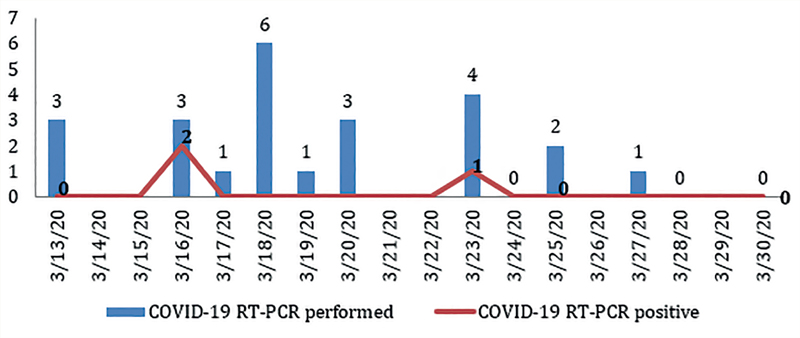
We retrospectively reviewed medical records of 24 patients with a diagnosis of solid cancer and hematologic malignancies who presented to the ED with respiratory symptoms at the Centro de Oncologia e Hematologia Einstein Familia Dayan-Daycoval (São Paulo, Brazil) from March 13 to March, 29, 2020. We recorded demographic, clinical and treatment data. All patients underwent COVID-19 diagnostic testing by RT-PCR, and 20 also collected a multiplex panel for 15 respiratory viruses in upper respiratory tract specimens.Supplementary Figure 1 demonstrates the number of COVID-19 RT-PCR tests performed daily.
The study was approved by the ethics comittee of Hospital Israelita Albert Einstein (Protocol 30978820.0.0000.0071)
Eleven patients (46%) had solid cancer, and the remaining 13 (54%) had hematologic malignancies (Table 1). Detected viruses: SARS-COV-2 (n= 3 patients, 12%), rhinovirus (n= 3, 12%), coronavirus LN67 (n= 2, 8%), parainfluenza (n= 2, 8%), metapneumovirus, influenza A H1N1, and respiratory syncytial virus (n=1 each, 4%). One patient tested positive for both influenza A H1N1 and SARS-COV-2.
| Patient characteristics – N = 24 | N (%) / mean (range) |
|---|---|
| Age | 61 (33 – 95) |
| Primary diagnosis Solid Tumors | 11 (46%) |
| GI cancers | 3 |
| Breast | 3 |
| Lung | 2 |
| Ovary | 2 |
| Head and neck | 1 |
| Hematologic Malignancies | 13 (54%) |
| Multiple Myeloma | 5 |
| Acute leukemia | 3 |
| CLL | 2 |
| Lymphoma | 3 |
| SARS-COV-2 RT-PCR Positive* | 3 (12%) |
| Multiple Myeloma | 1 |
| CLL | 1 |
| Lymphoma | 1 |
| LGL | 1 |
One patient had a diagnosis of Multiple myeloma and LGL
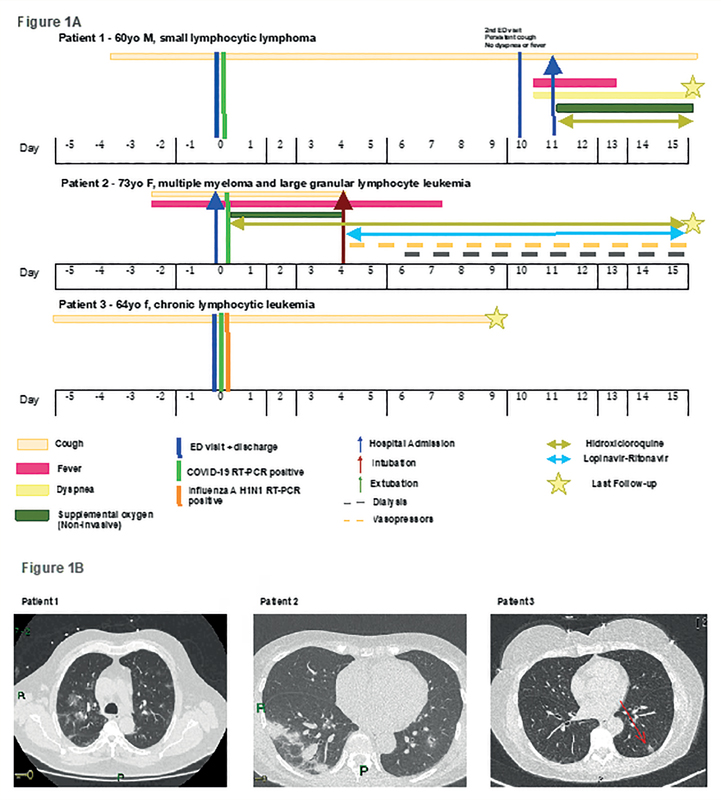
All 3 cases of COVID-19 occured in patients with hematologic malignancies (Table 1) – none on active treatment. All are alive (median follow-up 17 days). At the time of diagnosis, 1 patient was admitted to semiintensive care unit and 2 were discharged in stable condition – one was subsequently hospitalized 11 days later due to worsening symptoms. Clinical course of the cases are summarized inFigure 1A . Patient 1 and 2 are still admitted. CT scan was performed in all patients (representative findings inFigure 1B).
Figure 1 Clinical and radiologic characteristics of COVID-19 in 3 patients with hematologic malignancy.
SARS-CoV-2 is an emerging pathogen, and early data suggest higher morbimortality for patients with cancer3 4 5. Understanding the clinical spectrum of illness in this scenario is important for appropriate diagnosis and adequate management. Our study highlights the importance of considering alternate diagnosis during the initial pandemic, as only 12% of patients presenting to the emergency department with respiratory symptoms compatible with COVID-19 tested positive for SARS-COV-2, and 58% tested positive for other agents. Next, our data underlines the importance of patient education regarding worrisome symptoms after discharge, as onset of dyspnea can occur late – for patient 1, dyspnea requiring admission developed 14 days after symptom onset, while median time do dyspnea in unselected population is 8 days1.
Further, we describe the clinical course a case of influenza A H1N1 coinfection with COVID-19 in a patient with hematologic malignancy. Viral coinfection has been described in 5.8% of COVID-19 patients, and could potentially be more common in immunocompromised hosts6.
Ongoing studies are needed to assess the likelihood of SARS-CoV-2 infection in patients with solid and hematologic malignancies presenting with respiratory symptoms, as this will unequivocally evolve with the dynamic landscape of the pandemic. Moreover, additional data is central to determine patients at risk of readmission, to allow for the development of safe guidelines establishing factors that define need for hospitalization specifically for cancer patients.
Supplementary Figure 1 Number of COVID-19 RT-PCR tests performed each day.
Journal: Brazilian Journal of Oncology
DOI: 10.1055/s-00059887
e-issn: 2526-8732
Publisher: Thieme Revinter Publicações Ltda.
Publisher address: Rua do Matoso 170, Rio de Janeiro, RJ, CEP 20270-135, Brazil
Falha na comunicação com o serviço de processamento. Tente novamente.
No references with the required fields found.
Dados de acesso insuficientes para visualização no mapa.