The World Health Organization estimates the incidence of more than 18 million new cancer cases annually and has warned the international community about a fast increase for the upcoming decades
Only low- and middle-income countries have currently a higher percentage of deaths from communicable diseases rather than from noncommunicable diseases. It is estimated that, by 2030, almost all countries will have gone through the transition to a profile with a higher prevalence of non-communicable diseases.
Despite this unquestionable and growing need, there is a gap in Brazilian health professionals Oncology training, as alerted by Silvestrini et al
Different aspects of oncology are usually covered by various disciplines throughout medical graduation, as cancer involves multiple fields of medical practice. However, this approach usually occurs in a fragmented way, with a very specific focus, making it complex for students to build a comprehensive knowledge. Consolidating the main oncology subjects around a single discipline in medical graduation is essential.
A working group between the Federal University of Minas Gerais and the Brazilian Society of Clinical Oncology (SBOC) was developed in order to evaluate the teaching of oncology in Brazilian medical graduation courses. The present work comprises a quantitative survey of the current panorama on Oncology disciplines offered by medical graduation courses. The present evaluation aims at supporting future directions for better Oncology training in medical schools in Brazil.
A descriptive review of the curricular program and pedagogical plan of each medical course in Brazil was developed.
The data were listed in a spreadsheet and characterized as the frequency for variables of interest in order to chart the portrait of oncology teaching in Brazilian medical schools. A georeferenced map was built, with Khartis 2.3.0 program, for a better graphic projection of the oncology course distribution throughout country.
The list of registered and active Brazilian medical schools in 2019 was assessed by consulting the portal of the National Registry of Courses and Institutions of Higher Education, e-Mec (
Oncology or Cancerology or other subjects that jointly addressed the following topics in the programs were considered in this analysis: epidemiology of oncological diseases; basic concepts of oncogenesis; cancer pathology; prevention and early diagnosis; and basics of treatment. The review of the course program consisted of obtaining the following data for each institution: Brazilian state of the institution, administrative sphere (private or public), presence of oncology disciplines and if it were mandatory or optional.
We also assessed extracurricular strategies that promotes complementary oncology education. The presence of study groups, also called academic leagues, was evaluated. The list of active and registered oncology academic leagues in 2019 was obtained through the Brazilian Association of Medical Leagues.
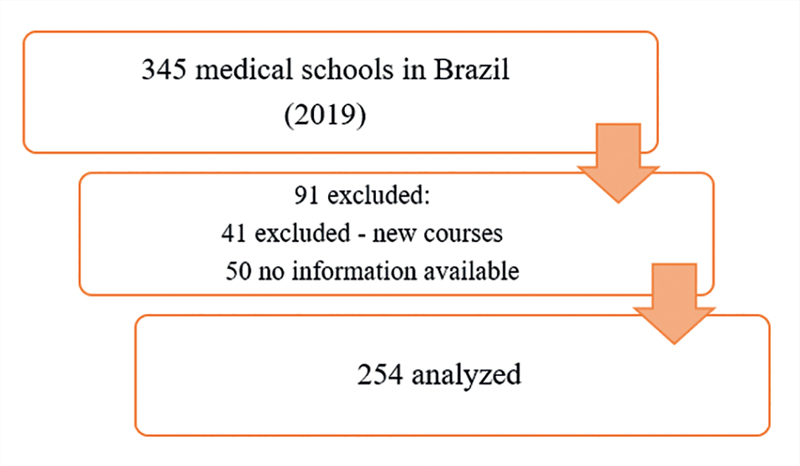
It was identified 345 medical schools registered in Brazil, according to e-Mec portal (data from November 2019). 41 institutions from this total were excluded from the study because they had no classes in the clinical cycle until the end of 2019 (those are new courses that started between 2018 and 2019). 50 medical schools did not have available information about the course program and/or pedagogical plan on their websites and did not respond to the contact attempts. Therefore, the curriculum of 254 medical schools were analyzed (
Figure 1 Number of medical schools assessed in the study.
The 254 medical schools that were included in the survey are geographically distributed in the country as shown on
| Characteristics | Number of Medical Schools |
|---|---|
| Region North | 22 (8,7%) |
| Midwest | 23 (9,0%) |
| South | 49 (19,3%) |
| Northeast | 51 (20,1%) |
| Southeast | 109 (42,9%) |
| Administrative management Public | 117 (46%) |
| Private | 137 (54%) |
| Total | 254 |
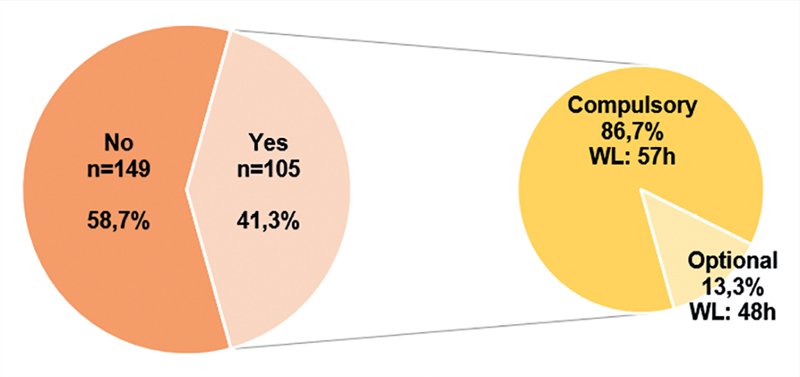
Regarding oncology discipline among the medical schools evaluated, 58.7%, do not offer the subject in their curriculum. Only 41.3% of the studied medical courses officially have the discipline in their medical curriculum (
Figure 2 Offer, modality and average workload (WL) of Oncology disciplines in the medical schools.
Among the 105 schools that offer oncology discipline, 91 (86.7%) offer it as mandatory and 14 (13.3%), as optional. The average workload in oncology, including theory and practice, is 57 h in mandatory disciplines and 48 h in the optional ones (
The evaluation between the administration system and the offer of oncology disciplines showed that the presence is higher in public medical schools. Only 36% of the evaluated private schools have the specific discipline at their courses (
| Administrative responsibility | Yes | No | Total |
|---|---|---|---|
| Public | 55 (47%) | 62 (53%) | 117 |
| Private | 50 (36%) | 87 (64%) | 136 |
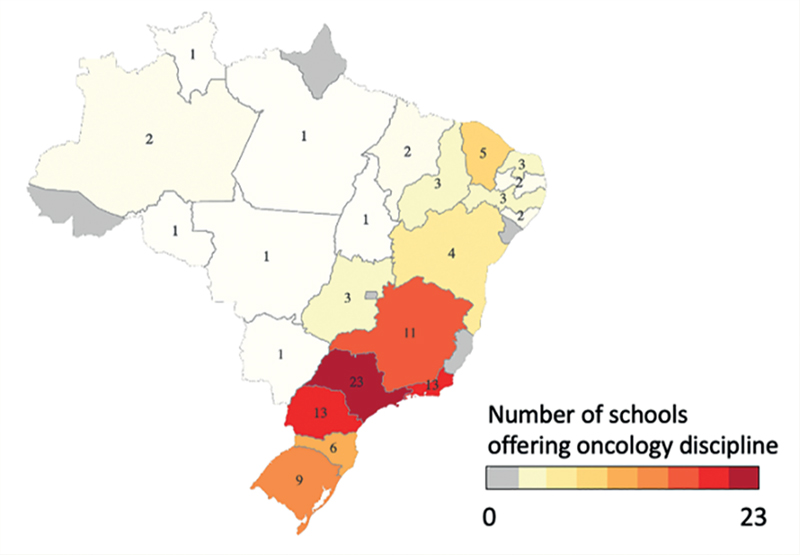
Regarding the geographical distribution of medical schools that embrace the discipline, there is a predominance in Southeast (45.7%) and South (22.9%) regions, mainly in São Paulo, Rio de Janeiro, Minas Gerais and Paraná. There is a strong shortage offer in other regions, with emphasis on the Midwest and North regions, with only 4.8% and 5.7% of the institutions, respectively (
Figure 3 Geo-referenced map of the oncology disciplines offers by Brazilian state.
| Demographic Region | Number of schools offering Oncology discipline |
|---|---|
| Midwest | 5 (4,8%) |
| North | 6 (5,7%) |
| Northeast | 22 (20,9%) |
| South | 24 (22,9%) |
| Southeast | 48 (45,7%) |
| Total | 105 |
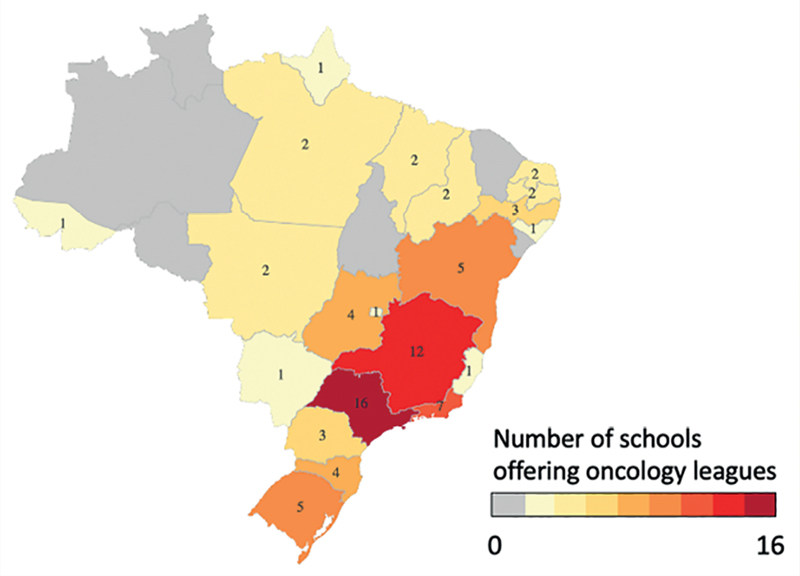
There are 77 active oncology academic leagues in Brazil in 2020, according to the Brazilian Association of Medical Leagues. A predominance of leagues is observed in states in the Southeast region (46.75%), mainly in São Paulo, Rio de Janeiro and Minas Gerais. There is a shortage of oncology leagues in the other regions, with emphasis on 8% in the Midwest and 4% of the North regions' institutions have registered oncology leagues (
Figure 4 Geo-referenced map of the presence of oncology student groups (academic leagues) by Brazilian State.
Cancer is an evolving threat expected to become the main cause of death in low- and middle-income countries, such as Brazil, by 2030. According to the GLOBOCAN, there are approximately 9.6 million cancer deaths worldwide yearly
The results of this study corroborate the existence of a gap in Brazilian medical education. The analysis carried out showed that only 41.3% (105) medical schools offer oncology or related disciplines in their curriculum, with 13.3% of them offering the discipline exclusively as an optional training. A second critical point is the limited number of hours dedicated to oncology, averaging 57 h in mandatory and 48 h in optional ones. This workload is significantly smaller when compared to other classic subjects in the curriculum. As a consequence, a significant percentage of recently graduated students (87%) consider the teaching of oncology insufficient during their academic path, as described by Ferreira et al.
The correlation between schools that have oncology disciplines and the administrative system shows that oncology education is more prevalent in public medical schools (47.8%). This phenomenon can be understood, in part, due to the exclusive fulfillment by most institutions of the minimum curriculum of the Brazilian National Curricular Guideline 2014
The geographical distribution of schools that teach the discipline of oncology in Brazil reveals a predominance in regions that concentrate the majority of new cancer cases in the country
Although still far from ideal, it is important to point the recent increase in the number of institutions which offer oncology disciplines. In 2012, Silvestrini et al.
A growing approach to oncology themes through nontraditional methods has been observed. Although not included in this study, a tendency of modular approach (Problem Based Learning methodology, PBL) of oncology topics, such as prevention and early diagnosis, were observed. In several institutions it was evaluated that the autonomous search for knowledge of oncology
There is an alarming gap in Oncology training in Brazilian medical schools, and tackling this issue is essential to improve cancer control in the country.
The World Health Organization estimates the incidence of more than 18 million new cancer cases annually and has warned the international community about a fast increase for the upcoming decades1. In Brazil, for the 2020-2022 triennial, the Ministry of Health estimated the incidence of approximately 625 thousand new cases annually.2
Only low- and middle-income countries have currently a higher percentage of deaths from communicable diseases rather than from noncommunicable diseases. It is estimated that, by 2030, almost all countries will have gone through the transition to a profile with a higher prevalence of non-communicable diseases.3 The Brazilian epidemiological shift is expected to occur until 2033, based on data from the Mortality Information System (SIM) and the National System of Notifiable Diseases (SINAN).4 Currently, the leading cause of mortality in the country is cardiovascular disease, closely followed by cancer5. In approximately 10% of Brazilian cities cancer is already the first cause of death.6 This scenario demands that health professionals, from all health care layers, should be able to implement primary prevention, early diagnosis and cancer patient support. This is the most effective and affordable strategy with the potential to impact on cancer incidence, morbidity and mortality in the country.
Despite this unquestionable and growing need, there is a gap in Brazilian health professionals Oncology training, as alerted by Silvestrini et al 12 and by the Brazilian National Cancer Institute (INCA)7.
Different aspects of oncology are usually covered by various disciplines throughout medical graduation, as cancer involves multiple fields of medical practice. However, this approach usually occurs in a fragmented way, with a very specific focus, making it complex for students to build a comprehensive knowledge. Consolidating the main oncology subjects around a single discipline in medical graduation is essential.
A working group between the Federal University of Minas Gerais and the Brazilian Society of Clinical Oncology (SBOC) was developed in order to evaluate the teaching of oncology in Brazilian medical graduation courses. The present work comprises a quantitative survey of the current panorama on Oncology disciplines offered by medical graduation courses. The present evaluation aims at supporting future directions for better Oncology training in medical schools in Brazil.
A descriptive review of the curricular program and pedagogical plan of each medical course in Brazil was developed.
The data were listed in a spreadsheet and characterized as the frequency for variables of interest in order to chart the portrait of oncology teaching in Brazilian medical schools. A georeferenced map was built, with Khartis 2.3.0 program, for a better graphic projection of the oncology course distribution throughout country.
The list of registered and active Brazilian medical schools in 2019 was assessed by consulting the portal of the National Registry of Courses and Institutions of Higher Education, e-Mec (https://emec.mec.gov.br/). The course program and pedagogical plan were obtained on universities/institutions websites. For institutions where it was not possible to obtain those documents through the institutional website, two attempts of each, either email or telephone, were done trying to acquire the data.
Oncology or Cancerology or other subjects that jointly addressed the following topics in the programs were considered in this analysis: epidemiology of oncological diseases; basic concepts of oncogenesis; cancer pathology; prevention and early diagnosis; and basics of treatment. The review of the course program consisted of obtaining the following data for each institution: Brazilian state of the institution, administrative sphere (private or public), presence of oncology disciplines and if it were mandatory or optional.
We also assessed extracurricular strategies that promotes complementary oncology education. The presence of study groups, also called academic leagues, was evaluated. The list of active and registered oncology academic leagues in 2019 was obtained through the Brazilian Association of Medical Leagues.
It was identified 345 medical schools registered in Brazil, according to e-Mec portal (data from November 2019). 41 institutions from this total were excluded from the study because they had no classes in the clinical cycle until the end of 2019 (those are new courses that started between 2018 and 2019). 50 medical schools did not have available information about the course program and/or pedagogical plan on their websites and did not respond to the contact attempts. Therefore, the curriculum of 254 medical schools were analyzed (Figure 1).
Figure 1 Number of medical schools assessed in the study.
The 254 medical schools that were included in the survey are geographically distributed in the country as shown onTable 1 . Concerning the administrative management, 117 schools are public and 137 are private (Table 1).
| Characteristics | Number of Medical Schools |
|---|---|
| Region North | 22 (8,7%) |
| Midwest | 23 (9,0%) |
| South | 49 (19,3%) |
| Northeast | 51 (20,1%) |
| Southeast | 109 (42,9%) |
| Administrative management Public | 117 (46%) |
| Private | 137 (54%) |
| Total | 254 |
Regarding oncology discipline among the medical schools evaluated, 58.7%, do not offer the subject in their curriculum. Only 41.3% of the studied medical courses officially have the discipline in their medical curriculum (Figure 2).
Figure 2 Offer, modality and average workload (WL) of Oncology disciplines in the medical schools.
Among the 105 schools that offer oncology discipline, 91 (86.7%) offer it as mandatory and 14 (13.3%), as optional. The average workload in oncology, including theory and practice, is 57 h in mandatory disciplines and 48 h in the optional ones (Figure 2). It was observed a tendency towards a modular approach (such as Problem Based Learning methodology, PBL), however, the teaching approach was not contemplated in the present study.
The evaluation between the administration system and the offer of oncology disciplines showed that the presence is higher in public medical schools. Only 36% of the evaluated private schools have the specific discipline at their courses (Table 2).
| Administrative responsibility | Yes | No | Total |
|---|---|---|---|
| Public | 55 (47%) | 62 (53%) | 117 |
| Private | 50 (36%) | 87 (64%) | 136 |
Regarding the geographical distribution of medical schools that embrace the discipline, there is a predominance in Southeast (45.7%) and South (22.9%) regions, mainly in São Paulo, Rio de Janeiro, Minas Gerais and Paraná. There is a strong shortage offer in other regions, with emphasis on the Midwest and North regions, with only 4.8% and 5.7% of the institutions, respectively (Table 3 and Figure 3).
Figure 3 Geo-referenced map of the oncology disciplines offers by Brazilian state.
| Demographic Region | Number of schools offering Oncology discipline |
|---|---|
| Midwest | 5 (4,8%) |
| North | 6 (5,7%) |
| Northeast | 22 (20,9%) |
| South | 24 (22,9%) |
| Southeast | 48 (45,7%) |
| Total | 105 |
There are 77 active oncology academic leagues in Brazil in 2020, according to the Brazilian Association of Medical Leagues. A predominance of leagues is observed in states in the Southeast region (46.75%), mainly in São Paulo, Rio de Janeiro and Minas Gerais. There is a shortage of oncology leagues in the other regions, with emphasis on 8% in the Midwest and 4% of the North regions’ institutions have registered oncology leagues (Figure 4). The number of active leagues described here is probably underestimated because registration with the association is not mandatory, but it seems that the number of oncology leagues correlates to the discipline offer in the country regions.
Figure 4 Geo-referenced map of the presence of oncology student groups (academic leagues) by Brazilian State.
Cancer is an evolving threat expected to become the main cause of death in low- and middle-income countries, such as Brazil, by 2030. According to the GLOBOCAN, there are approximately 9.6 million cancer deaths worldwide yearly1. In Brazil, the annual cancer mortality data is from 2015, when the Ministry of Health reported about 210,000 deaths from the disease per year9. In this perspective, the need to act towards prevention, early diagnosis, treatment and support for cancer patients is critical and makes the adequate training of health professionals a priority.
The results of this study corroborate the existence of a gap in Brazilian medical education. The analysis carried out showed that only 41.3% (105) medical schools offer oncology or related disciplines in their curriculum, with 13.3% of them offering the discipline exclusively as an optional training. A second critical point is the limited number of hours dedicated to oncology, averaging 57 h in mandatory and 48 h in optional ones. This workload is significantly smaller when compared to other classic subjects in the curriculum. As a consequence, a significant percentage of recently graduated students (87%) consider the teaching of oncology insufficient during their academic path, as described by Ferreira et al.10.
The correlation between schools that have oncology disciplines and the administrative system shows that oncology education is more prevalent in public medical schools (47.8%). This phenomenon can be understood, in part, due to the exclusive fulfillment by most institutions of the minimum curriculum of the Brazilian National Curricular Guideline 201411, which does not include the mandatory teaching of oncology in medical training.
The geographical distribution of schools that teach the discipline of oncology in Brazil reveals a predominance in regions that concentrate the majority of new cancer cases in the country2. However, there is an alarming lack of specific education in oncology in other regions, with emphasis on the Midwest and North regions, as shown. In these regions, the incidence of preventable cancers2, such as cervical cancer, has a huge impact on the population and could be particularly decreased with better medical training in oncology.
Although still far from ideal, it is important to point the recent increase in the number of institutions which offer oncology disciplines. In 2012, Silvestrini et al.12 reported a worrying scenario in which only 30% (33 schools) of a total of 110 institutions included the approach of oncology themes in their curriculum. At that time, there was already a clear concentration of these schools in the South and Southeast regions. The majority of schools that offer oncology disciplines are still the public ones (39.4% in 2012 and 47% in 2019), even with a significant increase of private institutions in the last years. It is worth mentioning that there are differences in methodology between the present and Silvestrini’s previous work, but this does not preclude the observation of the temporal improvement.
A growing approach to oncology themes through nontraditional methods has been observed. Although not included in this study, a tendency of modular approach (Problem Based Learning methodology, PBL) of oncology topics, such as prevention and early diagnosis, were observed. In several institutions it was evaluated that the autonomous search for knowledge of oncology10, through academic leagues and extracurricular activities, tools designed to overcome the curricular restrictions exposed here. The existence of 77 academic leagues corroborates the students’ perception about the insufficiency of oncological topics in the standard curriculum, requiring the search for complementary training. It should be noted that the presence of extracurricular activities does not replace the need to include oncology subjects in the obligatory curriculum.
There is an alarming gap in Oncology training in Brazilian medical schools, and tackling this issue is essential to improve cancer control in the country.
Journal: Brazilian Journal of Oncology
DOI: 10.1055/s-00059887
e-issn: 2526-8732
Publisher: Thieme Revinter Publicações Ltda.
Publisher address: Rua do Matoso 170, Rio de Janeiro, RJ, CEP 20270-135, Brazil
Falha na comunicação com o serviço de processamento. Tente novamente.
No references with the required fields found.
Dados de acesso insuficientes para visualização no mapa.