
Uterine carcinosarcoma is a type of malignant neoplasm consisting of mixed histology, with epithelial and mesenchymal components.(
Most women affected by this neoplasm have a mean age of 65 years, and the clinical presentation is similar to that of uterine body tumors, with transvaginal bleeding. In general, they have a low overall survival rate due to late diagnosis and tumor aggressiveness. They often experience locally advanced disease or distant metastases at diagnosis. Metastases occur more frequently by the epithelial component that tends to spread initially lymphatically, as opposed to the sarcomatous component that tends to spread hematogenously. Despite curative treatment, there is a high risk of locoregional and distant recurrences, demanding stricter surveillance.(
Another interesting aspect is that the histology of the tumor apparently revealed that there were two lesions without any connection, something that was later refuted by immunohistochemistry, which revealed, however, that it was the same lesion and that it underwent a transformation called epithelial-mesenchymal transition, a complex phenomenon also described in this article.
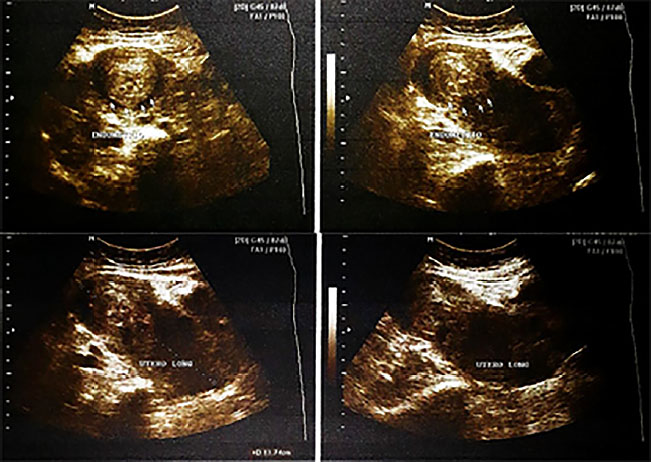
Female patient, white, 59 years old, menarche at 10 years, sexarche at 27 years, menopause at 52 years, G0P0A0, overweight, with hypertension, was admitted to the surgical oncology service with mild pain in the mesogastrium and daily metrorrhagia for six months, interrupted with tranexamic acid. After 2 months of using the medication, she reported pain intensification, from mild to moderate and transvaginal bleeding of small intensity. On physical examination, the uterus was palpable at the level of the umbilical scar and, on the specular examination, a large vegetative lesion was evidenced in the external orifice of the cervical canal and affecting the vaginal wall, friable and foul odor. Pelvic ultrasound detected an endometrial thickening of 25mm, an increased volume of uterus (178cm2) and a heterogeneous echotexture of the cervix (
Figura 1 Pelvic ultrasound showing uterus of regular pear-shaped appearance and surface. Increased volume = 178.6cm3, heterogeneous myometrial echotexture, heterogeneous thickening of the cervix, and the sonographic appearance of the endometrium is irregular (25mm, normal = 5mm). Nonvisualized ovaries. Full bladder, regular surface, shape and normal volumes, in ecostructures inside.
Surgical hysteroscopy showed multiple, voluminous, cystic, friable and tubular vaginal canal lesions. However, there were technical difficulties to overcome the lesion, excising fragments of a polypoid-configuration neoplasm. Histopathological analysis of the fragments showed atypical oval and fusiform cells, some pleomorphic, with round nuclei, evident nucleolus, presence of mitosis, eosinophilic cytoplasm, involving typical endometrial glands, amid loose stroma with areas of recent hemorrhage and necrosis; suggestive of Müllerian adenosarcoma. Pelvis CT reinforced the ultrasound findings. She was then submitted to the surgical procedure, with intraoperative findings of ascitic fluid in moderate amount, topical uterus with the presence of a large mass exceeding the uterine cervix, but without adhesions to the vaginal walls. Total hysterectomy, bilateral adnexectomy and pelvic lymphadenectomy were performed, en bloc resection of the lesion. The patient progressed well, being discharged without complications.
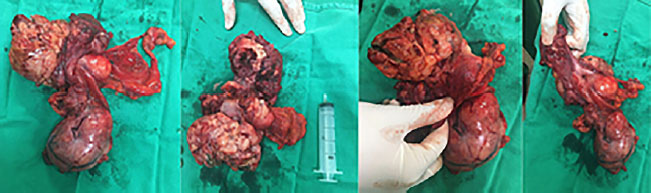
The ascitic fluid revealed a suspicious cytological aspect of neoplastic cells and the pathological study of the material identified two distinct tumors, with no connection between them (
Figura 2 Images of the product of total hysterectomy, weighing 575g, measuring 17.0 x 8.0 x 7.5cm, with smooth serosa and evident vessels. The larger lesion measured 11.5 x 9.5 x 7.5cm, with 0.1cm thickness, the surface is white, externally vegetative and friable. The smaller lesion measured 9.5 x 8.5 x 6.5cm, with a white and friable surface.
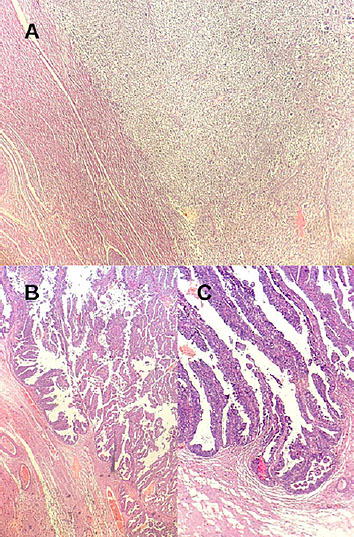
Figura 3 A. Histological sections stained in HE shows endometrial neoplasm with atypical round cell component, with inconspicuous cytoplasmic limits, large nuclei, sparse chromatin, arranged incohesively, with stretches of myxoid stroma. In a smaller increase, neoplastic tissue intersecting with normal myometrium on the right; B. Presence of neoplasia of epithelial origin, forming primitive glands that invade the myometrium, with cells of pleomorphic, hyperchromatic nuclei, conspicuous nucleoli, in addition to mitoses; C. Epithelial tissue invading the myometrium, with cells of distinctly neoplastic characteristics. In greater increase than the anterior image.
| Immunohistochemistry | ||
|---|---|---|
| Antibody | Clone | Result |
| Actin smooth muscle (alpha) | 1 to 4 | Negative |
| Anticytokeratin | 5.2 CAM | Negative |
| CD10 | 56C6 | Positive in rare cells |
| CD99 | 12e7 | Negative |
| CD117 | Polyclonal | Negative |
| Cyclin D1 | SP4 | Negative |
| Cytokeratin | AE1/AE3 | Negative |
| CK7 | OV-TL 12/30 | Negative |
| CK20 | Ks 20.8 | Negative |
| Desmin | D33 | Positive |
| RHEA | E29 | Negative |
| PAX8 | MRQ-50 | Negative |
| RE | SP1 | Negative |
| RP | 1e2 | Negative |
| WT-1 | 6F-H2 | Nuclear negative |
Carcinosarcomas, also called malignant mixed Müllerian tumors, are endometrial carcinomas with a malignant sarcomatous component, which can assume homologous or heterologous elements.(
The incidence of carcinosarcomas is less than 5% of malignant neoplasms of the uterus.(
The reported patientis nulliparousandoverweight, which are considered risk factors because they allude to states of chronic hyperestrogenism. The association of tamoxifen, metabolic syndrome, early menarche, late menopause, and exogenous estrogen exposure isolated with endometrial hyperplasia, proliferative endometrial lesions and endometrial adenocarcinoma is also well established.(
The epithelial-mesenchymal transition is a process in which epithelial cells lose intercellular support and adopt a phenotype similar to that of the mesenchymal, through cytoskeletal remodeling and alteration of migratory activity (increasing the ability to generate metastases).(
Four theories concerning the histogenesis of carcinosarcomas are reported. They are theories of collision, combination, conversion, and composition.(
The monoclonal origin of carcinosarcoma is well established, so that immunohistochemistry shows great agreement between both components. However, some studies still cite the collision of the two biclonal lineages of different progenitor cells as a possible genesis of these tumors. The characterization of mutations and the genetic profile of carcinosarcomas has been improved with sequencing methods. The most common mutations are those of the genes PTEN, PARP1, TP53, PIK3/AKT/MTOR, FBXW7, CCNE1, CHD4, HER2, ARID1A among others; and the TP53 mutation is the most present. Other genetic associations include mutations in KRAS, PPP2R1A and BCOR, as well as abnormalities in the expression of H2A/H2B histones.(
The most prevalent symptom is postmenopausal transvaginal bleeding or premenopausal intermenstrual transvaginal bleeding. Other less common symptoms are palpable mass, pelvic pain, and urinary and fecal changes.(
The diagnosis usually occurs after the pathological study of the entire surgical specimen, since, macroscopically, a carcinosarcoma is indistinguishable from an endometrial carcinoma.(
Among the markers researched in immunohistochemistry from the total hysterectomy, only desmin and CD10 antibodies were positive in rare cells. The other ones were negative and, considering these results and the study of the surgical specimen, the most compatible diagnosis was high-grade papillary serous carcinoma with dedifferentiation to high-grade sarcoma through epithelial-mesenchymal transition (Figure 3). It is worth mentioning that pathologists consider carcinosarcoma as a high-grade endometrial carcinoma, both the pattern of recurrence and metastasis is very similar to that of carcinoma and not to sarcoma.(
Treatment is multimodal, with adjuvant surgery and chemotherapy and/or radiotherapy. Surgery is the main modality of initial treatment and has as objective complete cytoreduction (without macroscopic residual disease) or optimal cytoreduction (residual disease <1cm) and consists of total hysterectomy with bilateral salpingo-oophorectomy, omentectomy, pelvic lymphadenectomy and retroperitoneal, and can be performed openly or minimally invasively (laparoscopic or robotic). According to the guidelines of the European Society for Medical Oncology (ESMO) in the clinical practice guideline, concomitant or sequential chemotherapy and EBRT (external beam radiotherapy) are recommended even in the initial cases.(
The metastases are more derived from the epithelial component, and may, however, present metastasis of the sarcomatous component, or both. The epithelial component is initially disseminated lymphatically, while the mesenchymal component spreads loco-regionally or it is hematogenously disseminated, affecting lung, liver and bone.(
This study is interesting, in this perspective, because, considering these data, the present report would not be in accordance with the speculation that the lesions with metastases due to sarcomas were, in fact, due to the collision of two different tumors, according to the histological report that initially revealed to be distinct lesions with no connection to each other. However, the immunohistochemical study of the piece clarified that it was a monoclonal lesion, which had undergone metaplastic transdifferentiation from carcinoma to sarcoma, contrary to the collision theory presented by those authors.
Previous studies have indicated that the indications of aggressiveness came mainly from the epithelial component, since a serous or clear cell component is more associated with metastases, with greater lymphovascular invasion, greater depth of myometrial invasion and isthmic and cervical involvement, which are markers of worse prognosis of the disease.(
Other prognostic factors to be considered are myometrial involvement >50% of its thickness, presence of heterologous components, incomplete cytoreduction (residual disease >1cm), proportional predominance of the sarcomatous component in the tumor and presence of compromised pelvic and/or retroperitoneal lymph nodes.(
The neoplasm of this report was staged as IIIC1 because it presented pelvic lymph node metastasis by the sarcomatous component, according to the staging of the FIGO. It is noteworthy that, macroscopically, the lesion consisted mainly of sarcoma.
The overall survival rate is very low and prognosis is more reserved than in other gynecological tumors with a similar high degree of carcinogenesis,(
This paper presents a case of uterine carcinosarcoma, a biphasic tumor whose behavior is still little known in a 59-year-old patient with risk factors for the development of uterine cancer.(
YESB Collection and assembly of data, Conception and design, Data analysis and interpretation, Manuscript writing
ACXL Collection and assembly of data, Conception and design, Manuscript writing
CDC Conception and design, Manuscript writing
RPC Manuscript writing
MLVC Conception and design, Final approval of manuscript, Manuscript writing
RMLVL Conception and design, Final approval of manuscript, Manuscript writing
Uterine carcinosarcoma is a type of malignant neoplasm consisting of mixed histology, with epithelial and mesenchymal components.(1,2) It corresponds to <5% of uterine tumors,(2,3) has an aggressive character, with mortality of up to 30% among malignant neoplasms of uterus.(2) Due to the mixed character of carcinosarcomas, several theories about their histogenesis(3) are proposed and recent evidence indicates that most of these neoplasms have monoclonal origin, with differentiation of carcinoma in sarcomatous elements.(2,4) This transformation is a process known as epithelial-mesenchymal transition, in which epithelial cells obtain mesenchymal cell phenotype.(5) Immunohistochemistry is fundamental for the identification of its components and for definitive diagnosis.(3)
Most women affected by this neoplasm have a mean age of 65 years, and the clinical presentation is similar to that of uterine body tumors, with transvaginal bleeding. In general, they have a low overall survival rate due to late diagnosis and tumor aggressiveness. They often experience locally advanced disease or distant metastases at diagnosis. Metastases occur more frequently by the epithelial component that tends to spread initially lymphatically, as opposed to the sarcomatous component that tends to spread hematogenously. Despite curative treatment, there is a high risk of locoregional and distant recurrences, demanding stricter surveillance.(6) The main objective of this work is to present the differential points of the study, which are related to the fact that the patient in the case is a little younger than the average age and the lymph node metastasis was caused by sarcoma, a very rare situation in the literature and little documented.
Another interesting aspect is that the histology of the tumor apparently revealed that there were two lesions without any connection, something that was later refuted by immunohistochemistry, which revealed, however, that it was the same lesion and that it underwent a transformation called epithelial-mesenchymal transition, a complex phenomenon also described in this article.
Female patient, white, 59 years old, menarche at 10 years, sexarche at 27 years, menopause at 52 years, G0P0A0, overweight, with hypertension, was admitted to the surgical oncology service with mild pain in the mesogastrium and daily metrorrhagia for six months, interrupted with tranexamic acid. After 2 months of using the medication, she reported pain intensification, from mild to moderate and transvaginal bleeding of small intensity. On physical examination, the uterus was palpable at the level of the umbilical scar and, on the specular examination, a large vegetative lesion was evidenced in the external orifice of the cervical canal and affecting the vaginal wall, friable and foul odor. Pelvic ultrasound detected an endometrial thickening of 25mm, an increased volume of uterus (178cm2) and a heterogeneous echotexture of the cervix (Figure 1).
Figura 1 Pelvic ultrasound showing uterus of regular pear-shaped appearance and surface. Increased volume = 178.6cm3, heterogeneous myometrial echotexture, heterogeneous thickening of the cervix, and the sonographic appearance of the endometrium is irregular (25mm, normal = 5mm). Nonvisualized ovaries. Full bladder, regular surface, shape and normal volumes, in ecostructures inside.
Surgical hysteroscopy showed multiple, voluminous, cystic, friable and tubular vaginal canal lesions. However, there were technical difficulties to overcome the lesion, excising fragments of a polypoid-configuration neoplasm. Histopathological analysis of the fragments showed atypical oval and fusiform cells, some pleomorphic, with round nuclei, evident nucleolus, presence of mitosis, eosinophilic cytoplasm, involving typical endometrial glands, amid loose stroma with areas of recent hemorrhage and necrosis; suggestive of Müllerian adenosarcoma. Pelvis CT reinforced the ultrasound findings. She was then submitted to the surgical procedure, with intraoperative findings of ascitic fluid in moderate amount, topical uterus with the presence of a large mass exceeding the uterine cervix, but without adhesions to the vaginal walls. Total hysterectomy, bilateral adnexectomy and pelvic lymphadenectomy were performed, en bloc resection of the lesion. The patient progressed well, being discharged without complications.
The ascitic fluid revealed a suspicious cytological aspect of neoplastic cells and the pathological study of the material identified two distinct tumors, with no connection between them (Figure 2). The major vegetative lesion measuring 11.5 x 9.5 x 7.5cm was diagnosed as a high-grade stromal endometrial sarcoma, with invasion of more than 50% of the myometrium with the presence of lymphatic invasion, without evidence of apparent perineural invasion and without detection of glandular focus of differentiation (Figure 3). The other minor lesion measuring 9.5 x 8.5 x 6.5cm was diagnosed as a highgrade serous adenocarcinoma with uterine serous infiltration and vascular invasion present (Figure 3). Due to the large deformity of the surgical specimen, neither the cervix nor adnexa uteri were identified. In the product of pelvic lymphadenectomy, there was one compromised lymph node of nine by sarcoma of the endometrial stroma of high degree (1/9). By FIGO classification, the lesions were staged as IIIC1 for sarcoma and IIIA for adenocarcinoma. The immunohistochemistry of the sample resulting from the total hysterectomy was performed with the antibodies actin smooth muscle (alpha), anti-cytokeratin, CD10, CD99, CD117, cyclin D1, cytokeratin, CK7, CK20, desmin, EMA, PAX8, RE, RP and WT-1, and the profile revealed positivity only for CD10 antibody in rare cells and for desmin antibody (Table 1); profile compatible with papillary serous carcinoma of high-grade dedifferentiated for sarcoma (epithelial-mesenchymal transition). She was referred to clinical oncology for adjuvant treatment.
Figura 2 Images of the product of total hysterectomy, weighing 575g, measuring 17.0 x 8.0 x 7.5cm, with smooth serosa and evident vessels. The larger lesion measured 11.5 x 9.5 x 7.5cm, with 0.1cm thickness, the surface is white, externally vegetative and friable. The smaller lesion measured 9.5 x 8.5 x 6.5cm, with a white and friable surface.
Figura 3 A. Histological sections stained in HE shows endometrial neoplasm with atypical round cell component, with inconspicuous cytoplasmic limits, large nuclei, sparse chromatin, arranged incohesively, with stretches of myxoid stroma. In a smaller increase, neoplastic tissue intersecting with normal myometrium on the right; B. Presence of neoplasia of epithelial origin, forming primitive glands that invade the myometrium, with cells of pleomorphic, hyperchromatic nuclei, conspicuous nucleoli, in addition to mitoses; C. Epithelial tissue invading the myometrium, with cells of distinctly neoplastic characteristics. In greater increase than the anterior image.
| Immunohistochemistry | ||
|---|---|---|
| Antibody | Clone | Result |
| Actin smooth muscle (alpha) | 1 to 4 | Negative |
| Anticytokeratin | 5.2 CAM | Negative |
| CD10 | 56C6 | Positive in rare cells |
| CD99 | 12e7 | Negative |
| CD117 | Polyclonal | Negative |
| Cyclin D1 | SP4 | Negative |
| Cytokeratin | AE1/AE3 | Negative |
| CK7 | OV-TL 12/30 | Negative |
| CK20 | Ks 20.8 | Negative |
| Desmin | D33 | Positive |
| RHEA | E29 | Negative |
| PAX8 | MRQ-50 | Negative |
| RE | SP1 | Negative |
| RP | 1e2 | Negative |
| WT-1 | 6F-H2 | Nuclear negative |
Carcinosarcomas, also called malignant mixed Müllerian tumors, are endometrial carcinomas with a malignant sarcomatous component, which can assume homologous or heterologous elements.(7,8) Apparently, the epithelial and mesenchymal components derive from the same cell lineage, since apparently the epithelium undergoes an epithelial-mesenchymal transition, in view of the sharing of genetic changes in both parts of the tumor.(9-11) The report deals with a carcinosarcoma of the uterine body, whose primary lesion consisted of high-grade endometrial papillary serous carcinoma that suffered a sarcomatous dedifferentiation. Some interesting aspects of the present report are the fact that it is a very rare and aggressive type of tumor, as well as the presence of lymph node metastasis by sarcoma, which does not correspond to common situations, since most metastases of carcinosarcomas are usually due to the epithelial component.(12-14) Sarcoma comes from the dedifferentiation of carcinoma by means of epithelial-mesenchymal transition, characterized by the immunohistochemical study of the case.(15-19)
The incidence of carcinosarcomas is less than 5% of malignant neoplasms of the uterus.(6,16,17) Despite its rarity, this type of cancer is responsible for more than 15% of all deaths related to malignant neoplasms of the uterus.(13-18) The highest incidence is in afrodescendant and postmenopausal women, between 62 and 67 years, peaking at 65 years of age. (2,6,18) However, our case report presents a patient aged slightly younger than the age of peak incidence.
The reported patientis nulliparousandoverweight, which are considered risk factors because they allude to states of chronic hyperestrogenism. The association of tamoxifen, metabolic syndrome, early menarche, late menopause, and exogenous estrogen exposure isolated with endometrial hyperplasia, proliferative endometrial lesions and endometrial adenocarcinoma is also well established.(3-6)
The epithelial-mesenchymal transition is a process in which epithelial cells lose intercellular support and adopt a phenotype similar to that of the mesenchymal, through cytoskeletal remodeling and alteration of migratory activity (increasing the ability to generate metastases).(5,9,20) Epithelial cells have an arrangement that preserves the apical and basal polarity, through cell adhesion proteins, while mesenchymal cells are separated from each other by an extracellular matrix without this type of histological organization. This phenomenon, in the context of neoplasms, occurs with the loss of cell adhesion proteins, with the replacement of epithelial markers (downregulation of E-cadherin, catenins and claudins, for example) by mesenchymal markers (upregulation of smooth-muscle actin, fibronectin, and vimentin, for example).(15) This process occurs physiologically in embryogenesis (type 1) and tissue repair, due to regeneration, fibrosis, and inflammation (type 2). Type 3 corresponds to carcinogenesis, a process in which there is a local invasion and distant metastasis and, unlike other types of transition, it is a dysregulated process that gives the tumor an infiltrative property with metastatic potential. Initially, transcriptional repression of genes associated with epithelial cell junctions occurs, the apical-basal polarity of the epithelium is lost, leading to detachment of cells from the basal membrane due to changes in interactions with the extracellular matrix (degradation of basement membrane through the release of metalloproteinases). In summary, this epithelial plasticity contributes to the transdifferentiation of the epithelium to the mesenchyme, characterizing this mixed cancer composed of epithelial and spindle cells. It is noteworthy that inflammation is a process implicated in the epithelial-mesenchymal transition through the induction of adhering molecules and transcription factors. An example of chronic inflammatory status is obesity, considered a risk factor for some neoplasms.(2,4,15,16,18,21)
Four theories concerning the histogenesis of carcinosarcomas are reported. They are theories of collision, combination, conversion, and composition.(7,19,22) The collision theory predicts that the epithelial and mesenchymal components have distinct genesis; the combination theory describes that carcinosarcoma comes from two histological presentations that overlap but have a stem cell in common in tumorigenesis; the composition theory is described as one in which the fusiform component in histopathological findings is actually a presentation of a stromal pseudosarcomatous reaction.(7,8,11) And finally, the conversion theory is that the epithelial component undergoes a type 3 epithelial-mesenchymal transition, and this theory is mainly supported by the idea that the epithelial tissue appears as a high-grade epithelium, which has undergone successive epigenetic changes in microRNAs and histones, amplifications, in particular c-myc in the epithelial component.(8,14) The two most accepted theories are conversion and collision theories, which are not mutually exclusive.(7,18,19) Therefore, this theory of epithelial-mesenchymal dedifferentiation is the one that currently best explains the histogenesis of carcinosarcomas.(20)
The monoclonal origin of carcinosarcoma is well established, so that immunohistochemistry shows great agreement between both components. However, some studies still cite the collision of the two biclonal lineages of different progenitor cells as a possible genesis of these tumors. The characterization of mutations and the genetic profile of carcinosarcomas has been improved with sequencing methods. The most common mutations are those of the genes PTEN, PARP1, TP53, PIK3/AKT/MTOR, FBXW7, CCNE1, CHD4, HER2, ARID1A among others; and the TP53 mutation is the most present. Other genetic associations include mutations in KRAS, PPP2R1A and BCOR, as well as abnormalities in the expression of H2A/H2B histones.(4,6,14,19) Cytokines are related to the development of carcinosarcomas, such as epidermal growth factor (EGF), fibroblast growth factor (FGF), transforming growth factor-β (TGF-β), platelet-derived growth factor (PDGF), and interleukin-10 (IL-10) which they stimulate the growth of the epithelium and cause immunosuppression in the tumor microenvironment, favoring metastasis. A plausible explanation for the aggressiveness of this tumor, especially the epithelial component, is given by analyzing the vascular pattern of both components, so that studies have shown that carcinoma has higher microvascular density and higher expression of VEGF than sarcoma ‘this is associated with reduction of E-cadherin and others epithelial proteins1. The presence of circulating tumor cells (CTC1 may also help explain the higher proportion of epithelial cells with metastasis, since CTCs are made up of epithelial cells with incomplete epithelial-mesenchymal transition that infiltrate blood vessels and are considered precursors of hematogenous metastasis. Clinically, this can be verified by evaluating the pattern of metastases which are most commonly derived from carcinoma.(3,4,8,15,17,20,23)
The most prevalent symptom is postmenopausal transvaginal bleeding or premenopausal intermenstrual transvaginal bleeding. Other less common symptoms are palpable mass, pelvic pain, and urinary and fecal changes.(6,20,21) The patient in the report presented the triad of transvaginal bleeding, pelvic pain and palpable mass.(19,22) About 10% of patients already present distant metastases at diagnosis and 30-40% of cases with extrauterine involvement at the first presentation.(6) Commonly, the tumor presents as a polypoid lesion that can protrude from the cervix,(6,19) similar to the description of this report.
The diagnosis usually occurs after the pathological study of the entire surgical specimen, since, macroscopically, a carcinosarcoma is indistinguishable from an endometrial carcinoma.(15) Imaging exams play an important role in diagnosis, staging, and therapeutic planning. Ultrasound may show hyperechoic masses compared to the endometrium and show a thickening and/or heterogeneity of the endometrial range, similar to the ultrasound description of this report (Figure 1). Although CT plays a role in assessing local disease and distant metastasis, MRI has greater sensitivity in describing local boundaries and assessing metastatic disease. It is an excellent study method, allowing more accurate staging and risk stratification, such as percentage of myometrial invasion, local extension, invasion of adjacent organs and lymph node involvement. The MRI study also assists in surgical planning, regarding the need or not for pelvic and/or paraaortic lymphadenectomy and adds details to the biopsy data. The anatomy of the healthy tissue is well demonstrated in T2-weighted images, which usually depict a hypersignal of the endometrium surrounded by a hyposignal of the junctional zone and a myometrium of intermediate signal intensity. Endometrial carcinoma usually has T1-weighted isosignal and T2-weighted hyposignal when compared to healthy endometrium.(18,24) One finding is that sarcomatous differentiation can be identified by the early enhancement, distinguishing the carcinosarcoma of the uterus from tissues of exclusive epithelial origin. With the use of gadolinium, the epithelial component shows subtle homogeneous enhancement, obtained more slowly than the surrounding myometrium on dynamic T1-weighted images.(18,19)
Among the markers researched in immunohistochemistry from the total hysterectomy, only desmin and CD10 antibodies were positive in rare cells. The other ones were negative and, considering these results and the study of the surgical specimen, the most compatible diagnosis was high-grade papillary serous carcinoma with dedifferentiation to high-grade sarcoma through epithelial-mesenchymal transition (Figure 3). It is worth mentioning that pathologists consider carcinosarcoma as a high-grade endometrial carcinoma, both the pattern of recurrence and metastasis is very similar to that of carcinoma and not to sarcoma.(21) In this case, initially, due to technical limitations in obtaining the first sample in hysteroscopy, the tumor was initially confused with a Müllerian adenosarcoma, a predominantly mesenchymal tumor, but with a malignant stromal pattern, which is usually of low degree, and also with a benign glandular epithelial component, sometimes with atypical findings.(25) Müllerian adenosarcoma should be part of the list of differential diagnoses of uterine carcinosarcoma because it is also a biphasic tumor and with more subtle differences in relation to malignant mixed Müllerian tumors for a less experienced examiner.
Treatment is multimodal, with adjuvant surgery and chemotherapy and/or radiotherapy. Surgery is the main modality of initial treatment and has as objective complete cytoreduction (without macroscopic residual disease) or optimal cytoreduction (residual disease <1cm) and consists of total hysterectomy with bilateral salpingo-oophorectomy, omentectomy, pelvic lymphadenectomy and retroperitoneal, and can be performed openly or minimally invasively (laparoscopic or robotic). According to the guidelines of the European Society for Medical Oncology (ESMO) in the clinical practice guideline, concomitant or sequential chemotherapy and EBRT (external beam radiotherapy) are recommended even in the initial cases.(26) Chemotherapy or radiotherapy alone may be considered. Chemotherapy is platinum-based and taxanes (usually carboplatin and paclitaxel) for 6 cycles every 21 days, whose purpose is the treatment of micrometastatic disease. Adjuvant pelvic radiotherapy consists of external radiotherapy and/or vaginal brachytherapy, with the role of reducing the risk of locoregional recurrence, as well as being an option to treat patients with locoregional recurrent disease or treatment of recurrence without prior use of radiotherapy. In resectable metastatic disease, chemotherapy should be considered alongside surgical cytoreduction.(19,21) In unresectable disease, we should consider exclusive chemotherapy and/or immunotherapy.(14)
The metastases are more derived from the epithelial component, and may, however, present metastasis of the sarcomatous component, or both. The epithelial component is initially disseminated lymphatically, while the mesenchymal component spreads loco-regionally or it is hematogenously disseminated, affecting lung, liver and bone.(7,8,11) Although the epithelial component metastasize more than the mesenchymal component; interestingly, this report illustrates that one of the nine lymph nodes presented a metastasis by high-grade endometrial sarcoma, which does not represent the most common situation for this type of tumor, and this type of metastasis pattern, more common due to the epithelial component, has statistical support in the literature. Some authors speculate that the presence of a lymph node affected purely by a metastasis of sarcoma, without evidence of carcinoma, signals to a lesion whose carcinogenesis arose from the collision of two lines, soon coming from a biclonal lesion.(7,27)
This study is interesting, in this perspective, because, considering these data, the present report would not be in accordance with the speculation that the lesions with metastases due to sarcomas were, in fact, due to the collision of two different tumors, according to the histological report that initially revealed to be distinct lesions with no connection to each other. However, the immunohistochemical study of the piece clarified that it was a monoclonal lesion, which had undergone metaplastic transdifferentiation from carcinoma to sarcoma, contrary to the collision theory presented by those authors.
Previous studies have indicated that the indications of aggressiveness came mainly from the epithelial component, since a serous or clear cell component is more associated with metastases, with greater lymphovascular invasion, greater depth of myometrial invasion and isthmic and cervical involvement, which are markers of worse prognosis of the disease.(7,12,13)
Other prognostic factors to be considered are myometrial involvement >50% of its thickness, presence of heterologous components, incomplete cytoreduction (residual disease >1cm), proportional predominance of the sarcomatous component in the tumor and presence of compromised pelvic and/or retroperitoneal lymph nodes.(12,13) Regarding prognosis, the overall survival in five years is about 30%, varying according to staging: I – II: 59%, III: 25%, and IV: 9%. There is also a correlation between overall 5-year survival and the histological degree of endometrial carcinoma.(7,18,19)
The neoplasm of this report was staged as IIIC1 because it presented pelvic lymph node metastasis by the sarcomatous component, according to the staging of the FIGO. It is noteworthy that, macroscopically, the lesion consisted mainly of sarcoma.
The overall survival rate is very low and prognosis is more reserved than in other gynecological tumors with a similar high degree of carcinogenesis,(12,18,19) and most patients die of local recurrence.(7) Patients should be followed up with greater surveillance, regardless of the stage of the disease, as recurrence may occur in more than 50% despite standard treatment.(12-19) As carcinosarcoma is considered as part of the group of high-risk endometrial carcinomas due to their aggressiveness, the European Society for Medical Oncology (ESMO), in the clinical practice guideline, recommends that physical and gynecological examination be taken in the first 3 years, every 3 months, during this surveillance period and then, every 6 months, until the end of 5 years if no residual or recurrent disease is detected.(26)
This paper presents a case of uterine carcinosarcoma, a biphasic tumor whose behavior is still little known in a 59-year-old patient with risk factors for the development of uterine cancer.(2,6,18) The report presents differential aspects because it is a very rare malignant tumor, whose immunohistochemical study reinforced the hypothesis of the epithelial-mesenchymal transition, proposed to explain the histogenesis of carcinosarcomas, as well as the fact that the sarcomatous component of this mixed tumor had metastasized to one of the pelvic lymph nodes. (7,19,27) The work illustrates correspondences of this case with the scientific literature, differential aspects of the case and also reveals the importance of the diagnostic approach with immunohistochemistry for the definitive diagnosis and the multimodal therapeutic approach of this cancer by surgery and adjuvant treatment with chemotherapy.(8,9,18,19)
YESB Collection and assembly of data, Conception and design, Data analysis and interpretation, Manuscript writing
ACXL Collection and assembly of data, Conception and design, Manuscript writing
CDC Conception and design, Manuscript writing
RPC Manuscript writing
MLVC Conception and design, Final approval of manuscript, Manuscript writing
RMLVL Conception and design, Final approval of manuscript, Manuscript writing
Journal: Brazilian Journal of Oncology
DOI: 10.1055/s-00059887
e-issn: 2526-8732
Publisher: Thieme Revinter Publicações Ltda.
Publisher address: Rua do Matoso 170, Rio de Janeiro, RJ, CEP 20270-135, Brazil
Falha na comunicação com o serviço de processamento. Tente novamente.
1. Zhao, S and Bellone, S and Lopez, S and Thakral, D and Schwab, C and English, DP. Mutational landscape of uterine and ovarian carcinosarcomas implicates histone genes in epithelial-mesenchymal transition. Proc Natl Acad Sci USA [online]. 2016, vol. 113, p. 12238-43. https://doi.org/10.1073/pnas.1614120113 Ver referência
2. Matsuo, K and Ross, MS and Machida, H and Blake, EA and Roman, LD. Trends of uterine carcinosarcoma in the United States. J Gynecol Oncol [online]. 2018, vol. 29, p. e22. https://doi.org/10.3802/jgo.2018.29.e22 Ver referência
3. Lopez-Garcia, MA and Palacios, J. Pathologic and molecular features of uterine carcinosarcomas. Semin Diagn Pathol [Internet] [online]. 2010, vol. 27, p. 274-86.
4. Cherniack, AD and Shen, H and Walter, V and Stewart, C and Murray, BA and Bowlby, R. Integrated molecular characterization of uterine carcinosarcoma. Cancer Cell [Internet] [online]. 2017, vol. 31, p. 411-23.
5. Chen, T and You, Y and Jiang, H and Wang, ZZ. Epithelial-mesenchymal transition (EMT): a biological process in the development, stem cell differentiation, and tumorigenesis. J Cell Physiol [online]. 2017, vol. 232, p. 3261-72. https://doi.org/10.1002/jcp.25797 Ver referência
6. Kord, A and Rabiee, B and Elbaz Younes, I and Xie, KL. Uterine carcinosarcoma: a case report and literature review. Case Rep Obstetr Gynecol [Internet] [online]. 2020, vol. 2020, p. 8816348.
7. McCluggage, WG. Malignant biphasic uterine tumours: carcinosarcomas or metaplastic carcinomas?. J Clin Pathol [online]. 2002, vol. 55, p. 321-5. https://doi.org/10.1136/jcp.55.5.321 Ver referência
8. Borrego, SN and Lengyel, E and Kurnit, KC. Molecular characterizations of gynecologic carcinosarcomas: a focus on the immune microenvironment. Cancers [Internet] [online]. 2022, vol. 14, p. 4465.
9. Zhang, Y and Weinberg, RA. Epithelial-to-mesenchymal transition in cancer: complexity and opportunities. Front Med [Internet] [online]. 2018, vol. 12, p. 361-73.
10. Koskas, M and Amant, F and Mirza, MR and Creutzberg, CL. Cancer of the corpus uteri: 2021 update. Int J Gynecol Obstet [online]. 2021, vol. 155, p. S45-S60. https://doi.org/10.1002/ijgo.13866 Ver referência
11. Brito, PA and Silverberg, SG and Orenstein, JM. Carcinosarcoma (Malignant mixed müllerian (mesodermal) tumor) of the female genital tract: immunohistochemical and ultrastructural analysis of 28 cases. Hum Pathol [Internet] [online]. 1993, vol. 24, p. 132-42.
12. Harano, K and Hirakawa, A and Yunokawa, M and Nakamura, T and Satoh, T and Nishikawa, T. Prognostic factors in patients with uterine carcinosarcoma: a multi-institutional retrospective study from the Japanese Gynecologic Oncology Group. Int J Clin Oncol [Internet] [online]. 2016, vol. 21, p. 168-76.
13. Matsuo, K and Takazawa, Y and Ross, MS and Elishaev, E and Podzielinski, I and Yunokawa, M. Significance of histologic pattern of carcinoma and sarcoma components on survival outcomes of uterine carcinosarcoma. Ann Oncol [Internet] [online]. 2016, vol. 27, p. 1257-66.
14. Menderes, G and Schwab, C and Lopez, S and Black, J and Bellone, S and Silasi, A. Mutational landscape of uterine and ovarian carcinosarcomas. J Clin Oncol [online]. 2016, vol. 34, p. S5589.
15. Ribatti, D and Tamma, R and Annese, T. Epithelialmesenchymal transition in cancer: a historical overview. Transl Oncol [Internet] [online]. 2020, vol. 13, p. 100773.
16. Thompson, L and Chang, B and Barsky, SH. Monoclonal origins of malignant mixed tumors (carcinosarcomas): evidence for a divergent histogenesis. Am J Surg Pathol [Internet] [online]. 1996, vol. 20, p. 277-85.
17. Somarelli, JA and Boss, MK and Epstein, JI and Armstrong, AJ and Garcia-Blaco, MA. Carcinosarcomas: tumors in transition?. Histol Histopathol [online]. 2015, p. 673-87. https://doi.org/10.14670/HH-30.673 Ver referência
18. Ravishankar, P and Smith, DA and Avril, S and Kikano, E and Ramaiya, NH. Uterine carcinosarcoma: a primer for radiologists. Abdom Radiol [Internet] [online]. 2019, vol. 44, p. 2874-85.
19. Cantrell, LA and Blank, SV and Duska, LR. Uterine carcinosarcoma: a review of the literature. Gynecol Oncol [Internet] [online]. 2015, vol. 137, p. 581-8.
20. Chiu, HC and Li, CJ and Yiang, GT and Tsai, APY and Wu, MY. Epithelial to mesenchymal transition and cell biology of molecular regulation in endometrial carcinogenesis. J Clin Med [Internet] [online]. 2019, vol. 8, p. 439.
21. Lu, KH and Broaddus, RR. Endometrial cancer. N Engl J Med [online]. 2020, vol. 383, p. 2053-64. https://doi.org/10.1056/NEJMra1514010 Ver referência
22. Ribeiro, B and Silva, R and Dias, R and Patrício, V. Carcinosarcoma of the uterine cervix: a rare pathological finding originating from mesonephric remnants. BMJ Case Rep [online]. 2019, vol. 12, p. e227050. https://doi.org/10.1136/bcr-2018-227050 Ver referência
23. Emoto, M and Iwasaki, H and Ishiguro, M and Kikuchi, M and Horiuchi, S and Saito, T. Angiogenesis in carcinosarcomas of the uterus: differences in the microvessel density and expression of vascular endothelial growth factor between the epithelial and mesenchymal elements. Hum Pathol [online]. 1999, vol. 30, p. 1232-41.
24. Freeman, SJ and Aly, AM and Kataoka, MY and Addley, HC and Reinhold, C and Room, E. The revised fig staging system for uterine malignancies: implications for MR imaging. RadioGraphics [online]. 2012, vol. 32, p. 1805-27. https://doi.org/10.1148/rg.326125519 Ver referência
25. D’Angelo, E and Prat, J. Uterine sarcomas: a review. Gynecol Oncol [Internet] [online]. 2010, vol. 116, p. 131-9.
26. Oaknin, A and Bosse, TJ and Creutzberg, CL and Giornelli, G and Harter, P and Joly, F. Endometrial cancer: ESMO clinical practice guideline for diagnosis, treatment and follow-up. Ann Oncol [Internet] [online]. 2022, vol. 33, p. 860-77.
27. Sreenan, JJ and Hart, WR. Carcinosarcomas of the female genital tract. A pathologic study of 29 metastatic tumors: further evidence for the dominant role of the epithelial component and the conversion theory of histogenesis. Am J Surg Pathol [online]. 1995, vol. 19, p. 666-74.
Dados de acesso insuficientes para visualização no mapa.